6段階フック・エラー設計・Context シグナル
エンタープライズ品質の CLI を構築するには、(*Command).execute()(command.go:905-1045)における正確な実行順序の把握が不可欠です。この仕組みを理解していないと、「サブコマンドに PersistentPreRunE を追加した途端にルートコマンドの認証・Viper 初期化がスキップされる」「実行時の API エラーなのに 40 行の --help が出力され、エラー文字列が2回重複表示される」「Ctrl+C(SIGINT)押下時にリモート処理が中断されない」といった典型的な障害が発生します。
Source Code
from drawlib.canvas import save, setup
from drawlib.lines import line
from drawlib.shapes import rectangle
from drawlib.smartarts import ChevronProcess
from drawlib.styles import Styles
from drawlib.text import text

setup(width=144, height=62)

text(
    (72, 57),
    "Cobra (*Command).execute() 実行ライフサイクル (command.go:959-1045)",
    style=Styles.DarkBold.patch(text_size=12.0),
)

stages = ChevronProcess(
    style=Styles.Neutral,
    text_style=Styles.DarkBold.patch(text_size=10.0),
    description_style=Styles.Muted.patch(text_size=9.5),
    corner_angle=60.0,
    spacing=1.2,
    flat_left_end=True,
)
stages.add("1. OnInitialize", description="グローバル初期化")
stages.add(
    "2. PersistentPre",
    description="Root -> Child",
    style=Styles.PrimaryFlat,
    text_style=Styles.WhiteBold.patch(text_size=10.0),
    description_style=Styles.White.patch(text_size=9.5),
)
stages.add("3. PreRunE", description="ローカル前処理", style=Styles.PrimaryNeutral)
stages.add(
    "4. RunE",
    description="メイン処理",
    style=Styles.SecondaryFlat,
    text_style=Styles.WhiteBold.patch(text_size=10.0),
    description_style=Styles.White.patch(text_size=9.5),
)
stages.add("5. PostRunE", description="ローカル後処理", style=Styles.SecondaryNeutral)
stages.add("6. PersistentPost", description="Child -> Root", style=Styles.PrimaryNeutral)
stages.draw(xy=(4, 38), width=136, height=13)

# Bottom comparison: Default vs EnableTraverseRunHooks = true
rectangle((38, 17), width=64, height=22, style=Styles.Neutral.patch(shape_r=2.0))
text((38, 23.5), "デフォルト (EnableTraverseRunHooks = false)", style=Styles.DarkBold.patch(text_size=10.5))
text((38, 18.0), "下から上へ探索 (Child -> Parent -> Root)", style=Styles.Dark.patch(text_size=10.0))
text((38, 13.0), "【最初に見つかった1つだけ】を実行して break!", style=Styles.PrimaryBold.patch(text_size=10.0))
text((38, 8.5), "子のフックがルートの共通初期化を隠蔽してしまう!", style=Styles.Muted.patch(text_size=9.5))

rectangle((106, 17), width=64, height=22, style=Styles.PrimaryNeutral.patch(shape_r=2.0))
text((106, 23.5), "cobra.EnableTraverseRunHooks = true", style=Styles.DarkBold.patch(text_size=10.5))
text((106, 18.0), "PersistentPreRunE:  Root -> Parent -> Child", style=Styles.PrimaryBold.patch(text_size=10.0))
text((106, 13.0), "PersistentPostRunE: Child -> Parent -> Root", style=Styles.Dark.patch(text_size=10.0))
text((106, 8.5), "defer OnFinalize() はエラー時も必ず実行!", style=Styles.Muted.patch(text_size=9.5))

line((38, 38), (38, 28), arrow_head="->", style=Styles.PrimaryBold)
line((106, 38), (106, 28), arrow_head="->", style=Styles.PrimaryBold)

save()
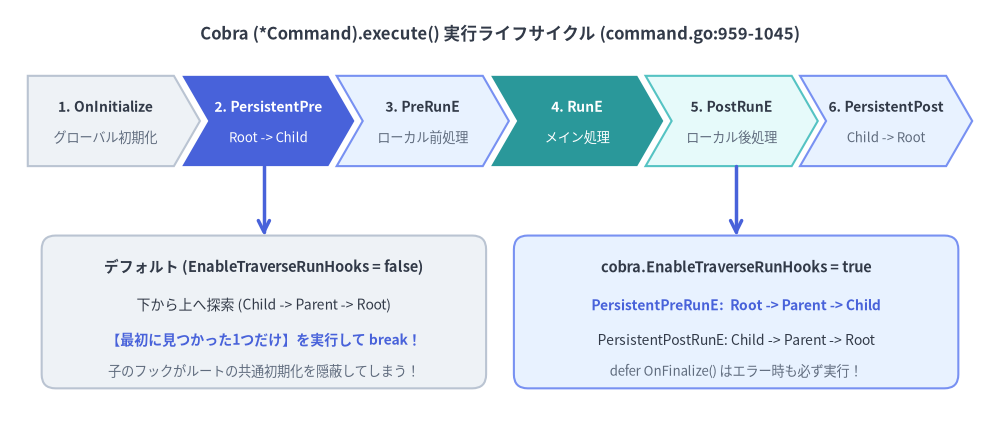
1. (*Command).execute() の厳密な実行順序(command.go)
ExecuteC() が実行対象の末端サブコマンド cmd を特定し、c.ParseFlags(a) でフラグ解析を終えると、cmd.execute(flags) の中で以下の9ステップが厳密な順序で実行されます。
| 順序 | 実行されるメソッド / フック | command.go 行番号 |
エラー発生時・短絡評価の挙動 |
|---|---|---|---|
| 1 | c.preRun()(cobra.OnInitialize 登録関数) |
959 行目 |
ValidateArgs の前に実行。直後の 961 行目で defer c.postRun()(OnFinalize)が登録される。 |
| 2 | c.ValidateArgs(argWoFlags)(cmd.Args) |
968 行目 |
位置引数エラー時は即座に return し、以降の *Run* フックは一切実行されない。 |
| 3 | PersistentPreRunE / PersistentPreRun |
972–998 行目 |
最も近い親の1つ(または EnableTraverseRunHooks == true 時は Root -> Child 全階層)を実行。 |
| 4 | PreRunE / PreRun |
999–1005 行目 |
対象コマンド固有の前処理を実行。エラー時はフラググループ検証前に中断。 |
| 5 | ValidateRequiredFlags() & ValidateFlagGroups() |
1007–1012 行目 |
RunE の直前で MarkFlagRequired および flag_groups.go の制約を検証。 |
| 6 | RunE / Run |
1014–1020 行目 |
コマンドのメインロジックを実行。 |
| 7 | PostRunE / PostRun |
1021–1027 行目 |
RunE が nil(成功)を返した場合のみ実行。 |
| 8 | PersistentPostRunE / PersistentPostRun |
1028–1042 行目 |
RunE と PostRunE が成功した場合のみ実行(Child -> Root 順)。 |
| 9 | defer c.postRun()(cobra.OnFinalize 登録関数) |
961 行目 |
ステップ 1 に到達していれば、RunE 等がエラーを返した場合でも defer により必ず実行される。 |
cobra.EnableTraverseRunHooks = true による親フックの連鎖実行
デフォルト(EnableTraverseRunHooks = false)では、Cobra は実行対象のサブコマンドから親方向(c -> Parent -> Root)へ遡り、最初に見つかった非 nil の PersistentPreRunE を1つ実行した時点で break します(command.go:989)。そのため、ルートコマンドの PersistentPreRunE でロガーや Viper を初期化していても、サブコマンド側で独自の PersistentPreRunE を定義した瞬間にルートの処理がスキップされてしまいます。
多階層 CLI では、必ず cobra.EnableTraverseRunHooks = true を設定し、親から子へミドルウェアのように連鎖実行させてください。
func init() {
	// PersistentPreRunE を上から下 (Root -> Parent -> Child)、
	// PersistentPostRunE を下から上 (Child -> Parent -> Root) の順で全階層実行する
	cobra.EnableTraverseRunHooks = true
}
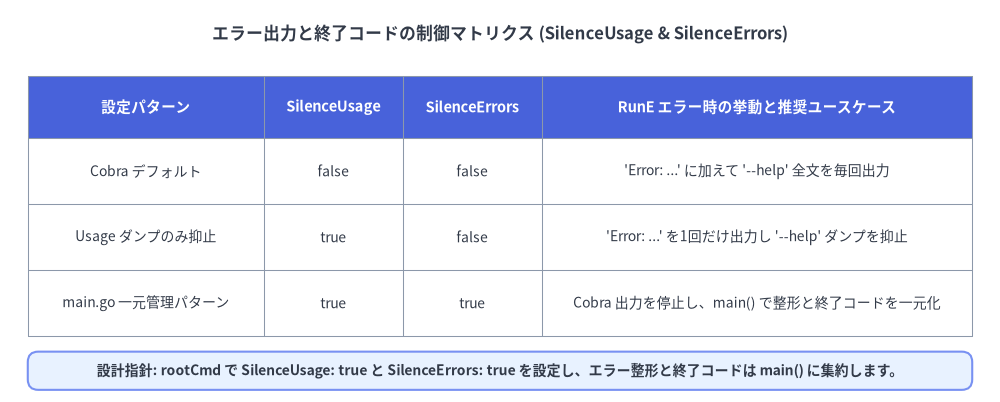
2. エラー二重出力の防止:SilenceUsage・SilenceErrors と終了コード設計
デフォルト設定のまま RunE がエラーを返すと、それがコマンド構文ミスではなく「API サーバーの 503 エラー」や「DB 接続タイムアウト」であっても、Cobra は ExecuteC()(command.go:1149-1160)の中で次の2つを自動出力します。
Error: <err.Error()>を標準エラー出力に表示する(SilenceErrors: falseの場合)。- コマンドの長い
--helpUsage 全文を標準エラー出力にダンプする(SilenceUsage: falseの場合)。
さらに main() 側でも if err != nil { fmt.Fprintln(os.Stderr, err) } を書いていると、同じエラーメッセージが --help 全文を挟んで2回表示されることになります。
Source Code
from drawlib.canvas import save, setup
from drawlib.shapes import rectangle
from drawlib.smartarts import Table
from drawlib.styles import Styles
from drawlib.text import text

setup(width=144, height=58)

text(
    (72, 53),
    "エラー出力と終了コードの制御マトリクス (SilenceUsage & SilenceErrors)",
    style=Styles.DarkBold.patch(text_size=12.0),
)

tbl = Table(
    cell_style=Styles.White,
    text_style=Styles.Dark.patch(text_size=10.0),
    header_cell_style=Styles.PrimaryFlat,
    header_text_style=Styles.WhiteBold.patch(text_size=10.5),
    border_style=Styles.MutedThin,
)

rows = [
    ["設定パターン", "SilenceUsage", "SilenceErrors", "RunE エラー時の挙動と推奨ユースケース"],
    [
        "Cobra デフォルト",
        "false",
        "false",
        "'Error: ...' に加えて '--help' 全文を毎回出力",
    ],
    [
        "Usage ダンプのみ抑止",
        "true",
        "false",
        "'Error: ...' を1回だけ出力し '--help' ダンプを抑止",
    ],
    [
        "main.go 一元管理パターン",
        "true",
        "true",
        "Cobra 出力を停止し、main() で整形と終了コードを一元化",
    ],
]

tbl.draw_flexible(
    xy=(4, 47),
    column_widths=[34, 20, 20, 62],
    row_heights=[9, 9.5, 9.5, 9.5],
    data=rows,
    align="top_left",
)

rectangle((72, 4.5), width=136, height=5.5, style=Styles.PrimaryNeutral.patch(shape_r=1.5))
text(
    (72, 4.5),
    "設計指針: rootCmd で SilenceUsage: true と SilenceErrors: true を設定し、エラー整形と終了コードは main() に集約します。",
    style=Styles.DarkBold.patch(text_size=10.0),
)

save()
3. ExecuteContext と signal.NotifyContext による優雅なシグナル中断
すべての cobra.Command は内部に context.Context を保持しており、cmd.Context() で取得できます。エントリーポイント(main.go)で signal.NotifyContext を使って os.Interrupt(SIGINT / Ctrl+C)と syscall.SIGTERM をバインドし、rootCmd.ExecuteContext(ctx) で実行することで、通信中の HTTP リクエストや gRPC ストリーム、子プロセスを安全にキャンセルできます。
package main

import (
	"context"
	"errors"
	"fmt"
	"os"
	"os/signal"
	"syscall"

	"github.com/spf13/cobra"
)

// ExitError は任意のプロセス終了コードを伴う構造化エラー型です。
type ExitError struct {
	Code int
	Err  error
}

func (e *ExitError) Error() string { return e.Err.Error() }
func (e *ExitError) Unwrap() error { return e.Err }

func main() {
	os.Exit(run())
}

func run() int {
	// 1. OS シグナル (SIGINT / SIGTERM) を Context のキャンセルにバインド
	ctx, stop := signal.NotifyContext(context.Background(), os.Interrupt, syscall.SIGTERM)
	defer stop()

	rootCmd := NewRootCommand()

	// 2. シグナル連動済みの Context を渡してコマンドツリーを実行
	if err := rootCmd.ExecuteContext(ctx); err != nil {
		if errors.Is(err, context.Canceled) {
			fmt.Fprintln(os.Stderr, "\nOperation canceled by signal (SIGINT/SIGTERM)")
			return 130 // POSIX 標準の SIGINT 終了コード (128 + 2)
		}
		var exitErr *ExitError
		if errors.As(err, &exitErr) {
			fmt.Fprintf(os.Stderr, "Error: %v\n", exitErr.Err)
			return exitErr.Code
		}
		fmt.Fprintf(os.Stderr, "Error: %v\n", err)
		return 1
	}
	return 0
}

func NewRootCommand() *cobra.Command {
	cobra.EnableTraverseRunHooks = true

	cmd := &cobra.Command{
		Use:           "mycli",
		Short:         "Context シグナル連動を備えた本番向け CLI",
		SilenceUsage:  true, // 実行時エラーで --help をダンプしない
		SilenceErrors: true, // エラー出力と終了コード制御を run() に一元化する
		RunE: func(cmd *cobra.Command, args []string) error {
			// 任意のフックや RunE 内で cmd.Context() からシグナル連動 Context を取得
			ctx := cmd.Context()
			select {
			case <-ctx.Done():
				return ctx.Err()
			default:
				cmd.Println("Executing workload with context...")
				return nil
			}
		},
	}
	return cmd
}